About
Summary
I am interested in the interfaces between evolutionary ecology, biodiversity- ecosystem functioning and restoration ecology.
- My current research focuses on the relative contribution of taxonomic, functional and phylogenetic diversity to ecosystem function and services.
- I have great interest in the mechanisms shaping plant communities and theory-driven ecological restoration.
- I am also very interested in broader scales, phylogenetic comparative methods, macroevolutionary patterns and the evolution of plant sex.
- Scientific coordinator of the tree diversity experiment EFForTS-BEE.
- Ambassador of the Center for Open Science.
Affiliation
Position: Associated Researcher
Institution:
University of Göttingen, Germany.
Departament:
Biodiversity, Macroecology & Biogeography
Address: Büsgenweg 1, 37077 Göttingen, Germany
E-mail:
gustavo.paterno@uni-goettingen.de
Education
PhD in Ecology
UFRN (Brazil) + TUM (Germany) + VUB (Belgium) + MQ (Australia)
2014–2018
Thesis: “Sex, Herbivores, and the Evolution of Flowers”
Award for Best Doctoral Thesis in Ecology
MSc in Ecology
UFRN, Brazil
2011–2013
Award for Best Master’s Thesis in Ecology
BSc in Ecology
UFRN, Brazil
2005–2010
Research Projects
Global Restore Project
Research synthesis for a changing world
Read moreEFForTS-BEE

A TreeDivNet Experiment in Sumatra, Indonesia
Read morePublications
Tree cover and habitat type mediate taxonomic and phylogenetic anuran diversity in Southeastern Peru
Abstract Understanding the drivers that shape anuran diversity is crucial for identifying conservation hotspots, particularly as global anuran declines threaten the reduction of their ecosystem functions across food chains. While studies have examined the influence of environmental and anthropogenic factors, few have explored their effects on multiple facets of diversity or considered how their effects vary across habitat types. Using an extensive dataset from Southeastern Peru, Western Amazonia, we quantified taxonomic and phylogenetic anuran diversity and used linear mixed-effects models to assess how environmental and anthropogenic drivers influenced them.
Read moreKey concepts and a world-wide look at plant recruitment networks
Abstract Plant–plant interactions are major determinants of the dynamics of terrestrial ecosystems. There is a long tradition in the study of these interactions, their mechanisms and their consequences using experimental, observational and theoretical approaches. Empirical studies overwhelmingly focus at the level of species pairs or small sets of species. Although empirical data on these interactions at the community level are scarce, such studies have gained pace in the last decade.
Read moreThe Phylogenetic Architecture of Recruitment Networks
Abstract Plant recruitment involves both stochastic and deterministic processes. Recruits may establish independently or interact nonrandomly with canopy plants. We explore this deterministic aspect by testing whether recruitment patterns are influenced by the phylogenetic history of canopy and recruiting plants. Since the effect of canopy plants in recruitment can be positive (facilitation), negative (competition) or neutral, we also estimated the phylogenetic signal separately for each interaction type.
Read moreDiverse and larger tree islands promote native tree diversity in oil palm landscapes
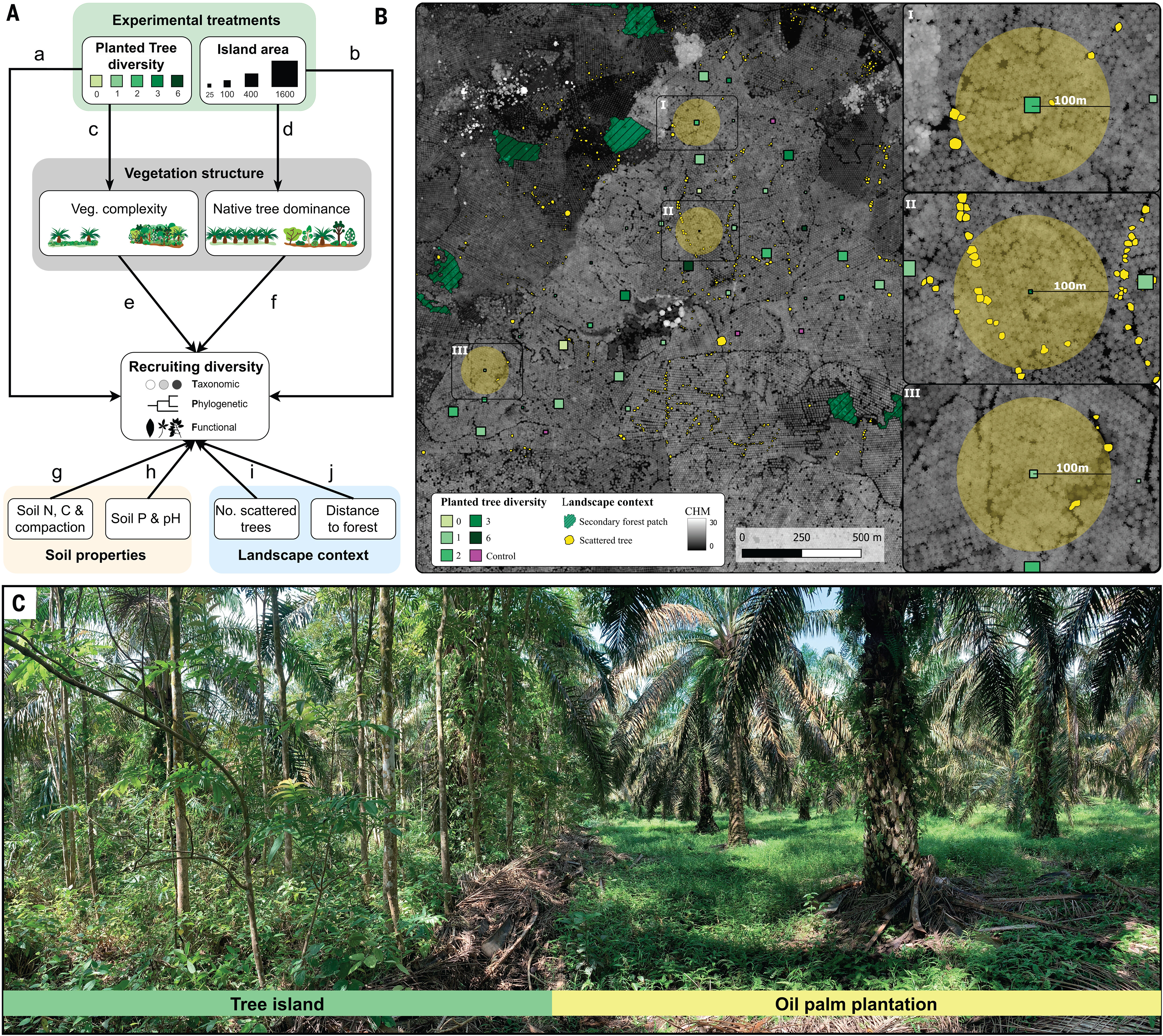
Abstract In monoculture-dominated landscapes, recovering biodiversity is a priority, but effective restoration strategies have yet to be identified. In this study, we experimentally tested passive and active restoration strategies to recover taxonomic, phylogenetic, and functional diversity of woody plants within 52 tree islands established in an oil palm landscape. Large tree islands and higher initial planted diversity catalyzed diversity recovery, particularly functional diversity at the landscape level.
Read moreFeatured categories
Tree diversity (5) Phylogenetic diversity (4) Biodiversity-ecosystem function (3) Restoration Ecology (3) TreeDivNet (3)